Image source and edits
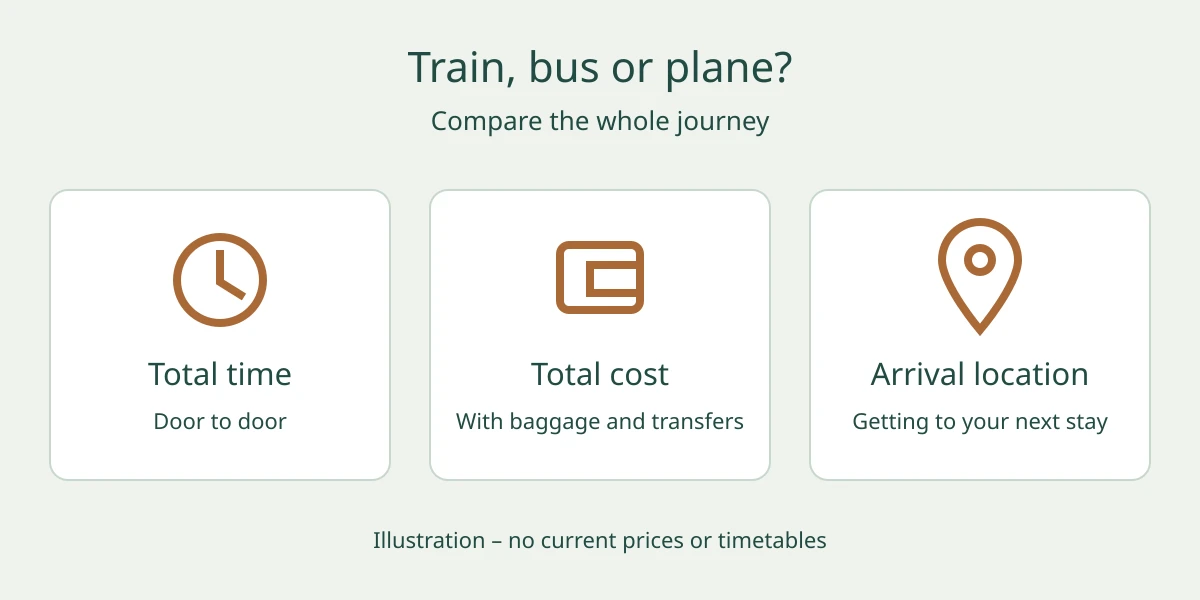
Compare the whole journey. Original SVG illustration with text translated into English; no other changes.
Train, bus or plane? Choosing how to travel between cities in Thailand
Reworked with AI assistance. The Swedish text, image and caption were reviewed and approved by Johan Lundgren. Sources were checked on 14 November 2026.
Train, bus or domestic flight? When travelling between cities in Thailand, it makes sense to compare the whole journey: from one place to stay to the next, including baggage, waiting time and connections. The lowest ticket price does not necessarily make for the cheapest or easiest day of travel.
Start with time, total cost and arrival location
Search for the same travel date and note when you could actually reach your destination. Add the journey to the station or airport, the time you need before departure and the onward journey after arrival. Then compare the final price with the baggage and seat or berth you need.
Also check what happens if you need to change or cancel. A low fare is less useful if its conditions do not suit your plans.
Flying: compare more than time in the air
Flying may be worth considering for a long journey when travel time matters. Bangkok has both Suvarnabhumi, with the airport code BKK, and Don Mueang, DMK. Check the airport name on each ticket, especially if you are connecting to another flight. Source
Baggage and other extras can affect the price. AirAsia’s fare comparison, for example, shows that checked baggage costs extra with its basic fare but is included in some packages. Check what your particular ticket covers before paying. Source
Trains: choose your station and seat or berth carefully
State Railway of Thailand has a booking system called D-Ticket, where you can search for departures and choose available seats or berths. Check which carriage and type of accommodation you are booking: a seat and a sleeping berth are different options. Source
Many long-distance trains in Bangkok use Krung Thep Aphiwat. Other trains still use the older Hua Lamphong station. Go by the station on your ticket, rather than just the place name Bangkok. Source
If you want to travel overnight, check that the service has the sleeping berth you want and that the arrival time works with your next accommodation or connection.
Buses: check the stops and comfort
Bangkok’s larger bus terminals include Mo Chit, Sai Tai Mai and Ekkamai. They are in different locations, so the departure terminal’s name is an important part of your booking. Source
Compare the actual service: seat type, journey time, breaks, baggage conditions and where you will be dropped off. Do not assume that a bus labelled VIP is always the cheapest or offers the same standard across different companies. The Transport Co. is one operator whose own channels you can start with; other companies may offer different departures and conditions.
A simple check before paying
- Are the date, departure point and arrival point correct?
- Are the baggage and seat or berth you need included?
- Have you allowed for connecting journeys and waiting time?
- Does the arrival time work even if your accommodation cannot check you in straight away?
- Do you understand the conditions for changes and cancellations?
Prices, timetables and availability vary. Use this comparison to choose between specific departures, rather than as a rule that one form of transport is always best.