Image source and edits
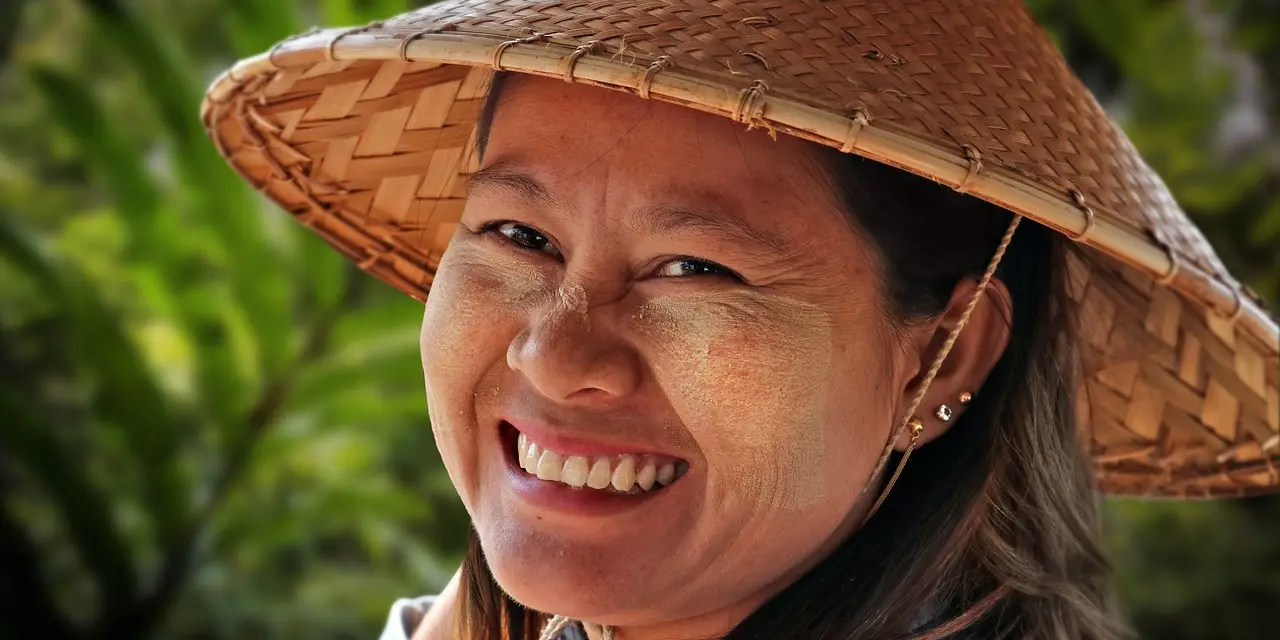
Burmese woman, Myanmar. Existing crop from WordPress; no further image editing.
Thanaka: the pale face paste and its tradition in Myanmar
Reworked with AI assistance. The Swedish text, image and caption were reviewed and approved by Johan Lundgren. Sources were checked on 14 November 2026.
The pale paste worn on the cheeks is called thanaka. In Myanmar, children and adults use it as a cosmetic and as part of a long cultural tradition. Here we explain how the paste is made, why it is worn and how to distinguish the tradition from claims of medical benefits.
Bark, water and a grinding stone
Thanaka, also spelt thanakha, is traditionally made by rubbing bark with water on a round stone slab. The creamy paste is applied to the skin. UNESCO’s account of the tradition mentions circles, leaves and flowers among the shapes used to decorate the face. Source
The raw material comes from trees grown in the dry areas of central Myanmar. A study of cultivation and trade describes both Hesperethusa crenulata and Limonia acidissima as sources of thanaka. The name therefore does not always refer to a single tree species or a single finished product. Source
Why do people wear thanaka?
Its appearance, scent and cooling sensation are part of the tradition. UNESCO describes how knowledge is passed down within families and how thanaka is also used at celebrations and in religious rituals. Men, women and children use it. It is therefore misleading to describe it solely as make-up for women. Source
The paste can be worn as a simple layer or in carefully drawn patterns. For anyone encountering the tradition for the first time, it is useful to know that it is part of everyday life, not just performances or festive dress.
Tradition is not the same as a proven treatment
Thanaka is used in traditional skincare, but this use does not prove that the paste treats a particular skin condition. A study from 2010 examined bark powder and extracts in the laboratory and reported findings including antioxidant and anti-inflammatory activity. Source
That is not the same as a clinical study showing that an ordinary thanaka paste treats acne in humans. Nor does the study establish a sun protection factor for paste mixed at home. We therefore do not use the findings as a promise of treatment or verified sun protection.
A living cultural tradition
Thanaka can be understood both as a cosmetic and as knowledge shared between generations. This account concerns the tradition in Myanmar. It says nothing about any individual’s ethnicity, occupation or reasons for wearing the paste.